Eurozone ministers agree bailout for ailing Spanish banks
By Paul Armstrong, CNN
July 11, 2012 -- Updated 1011 GMT (1811 HKT)
STORY HIGHLIGHTS
- Euro ministers agree 30 billion euro (US$36.9 billion) bailout package for Spain's banks
- Aimed at preventing Spain, eurozone's fourth largest economy, from needing bailout itself
- Madrid was also given an extra year to meet its steep budget deficit target
- Spain's banks suffering with bad debts mainly due to nation's property market crash
(CNN) -- Spain is to be offered an initial 30 billion euros (US$36.9 billion) to bail out its troubled banks following an emergency meeting of Eurozone finance ministers.
The agreement followed nine hours of talks in Brussels that concluded early Tuesday. It was aimed at preventing Spain, the eurozone's fourth largest economy, from needing a full bailout itself.
In June, European finance ministers agreed to set aside $150 billion to shore up the capital base of Spain's banks.
Madrid was also given an extra year to meet its steep budget deficit target, according to Jean Claude Juncker, Luxembourg's prime minister and the head of the Eurozone finance ministers group.
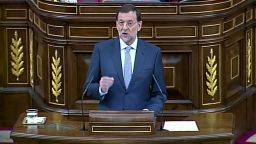
Spanish PM speaks on the economy
Spain looks for EU aid
Spain faces more bank downgrades
Open Mic: Spain's bank bailout
Spain had been told to cut the difference between its income and spending to within 5.3% of gross domestic product (GDP) by the end of 2012. But it will now be given until 2014 instead of 2013 to cut its deficit to below 3% of GDP.
Spain given extra time to cut deficit
"We are aiming at reaching a formal agreement in the second half of July, taking into account national parliamentary procedure, allowing for a first disbursement of 30 billion euros by the end of the month to be mobilized as a contingency in case of urgent needs in the Spanish banking system," Juncker said in a statement to reporters after the meeting.
The ministers from the 17-nation bloc met 10 days after their heads of government agreed to use its temporary bailout funds to recapitalize Spain's ailing financial system and to set up a joint supervisory body for the area's lenders.
Under the terms of the deal, this supervisory body will oversee the eurozone's banks and use the single currency area's rescue funds, the European Financial Stability Facility or European Stability Mechanism, to aid banks directly without adding to governments' debt.
However, the first cash injection will be filtered through Madrid's existing bailout fund.
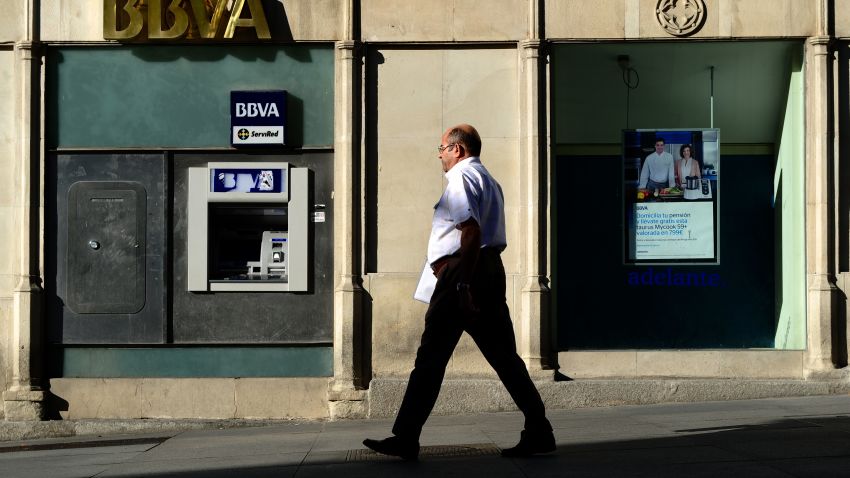
Audits commissioned by the Spanish government recently showed its banking sector -- beset by bad debt in the aftermath of the country's property market crash -- is likely to need 60 billion to 70 billion euros in extra cash to stay solvent.
Meanwhile, Spanish and Italian borrowing costs continued to rise to unsustainable levels Monday, with Spain's 10-year bond topping the critical 7% level.
CNN's Nina Dos Santos contributed to this report.

Part of complete coverage on
May 14, 2013 -- Updated 1326 GMT (2126 HKT)
The "rich man's club" of Europe faces economic decay as it struggles to absorb Europe's "poor people", according to economic experts on the troubled region.
May 7, 2013 -- Updated 1532 GMT (2332 HKT)
Unemployment at a 16-year high and the lowest approval rating for a president in modern French history; this is the wreckage from Francois Hollande's first year in office.
May 2, 2013 -- Updated 1044 GMT (1844 HKT)
As European financial markets close for the spring celebration of May Day, protesters across Europe and beyond have taken to the streets to demonstrate.
April 26, 2013 -- Updated 1210 GMT (2010 HKT)
As Croatia prepares to enter the 27-nation European Union, the country's Prime Minister says Italy must return to being the "powerhouse of Europe."
April 25, 2013 -- Updated 1656 GMT (0056 HKT)
Spain's unemployment rate rose to a record high of 27.2% in the first quarter of 2013, the Spanish National Institute of Statistics said Thursday.
April 12, 2013 -- Updated 1246 GMT (2046 HKT)
Turkey is a "source of inspiration" to show how Islam and democracy can go hand-in-hand, the country's deputy prime minister has told CNN.
March 28, 2013 -- Updated 1439 GMT (2239 HKT)
Cypriots are discussing the long-term effects of their 10 billion euro bailout. How come the Irish and the Spanish didn't lose their savings? Why us?
March 25, 2013 -- Updated 1355 GMT (2155 HKT)
The financial uncertainty in Cyprus is generating images of long lines at ATM machines and anti-European Union protests.
March 22, 2013 -- Updated 1130 GMT (1930 HKT)
Opinion: We must be careful to avoid panic and reckless measures that would exacerbate the crisis.
March 25, 2013 -- Updated 1815 GMT (0215 HKT)
Cyprus will "step up efforts in areas of fiscal consolidation." Where have we heard that before? Oh yes. Greece.
March 25, 2013 -- Updated 1813 GMT (0213 HKT)
Finland's political leaders held an informal summit in Saariselka, Lapland. Quest: This was an opportunity to see leaders "at their most honest."
March 27, 2013 -- Updated 1418 GMT (2218 HKT)
Cyprus has become the latest eurozone nation to apply for a bailout amid a financial crisis linked to debt defaults in Greece.
March 27, 2013 -- Updated 1449 GMT (2249 HKT)
BRICS leaders meet in South Africa to make deal on development bank. But instead of BRICS, today everyone is talking about the "CIVETS."
March 23, 2013 -- Updated 0139 GMT (0939 HKT)
The Cyprus debt crisis is being felt by the banks but also by the people who work at them. Nick Paton Walsh reports.
March 22, 2013 -- Updated 0010 GMT (0810 HKT)
CNN's Nick Paton Walsh reports on a Russian hotel maid caught up in Cyprus' financial crisis.
March 18, 2013 -- Updated 1608 GMT (0008 HKT)
Never underestimate the capacity of the Eurozone to shoot itself in both feet, says CNN's Richard Quest.
March 12, 2013 -- Updated 1100 GMT (1900 HKT)
Thousands of Greeks are unable to obtain life-saving drugs as pharmaceutical firms say they are limiting supplies to Greece over unpaid debts.
February 21, 2013 -- Updated 1603 GMT (0003 HKT)
Spain has seen hundreds of protests since the "Indignados" movement erupted in 2011, marches and sit-ins are now common sights in the capital.
Today's five most popular stories